Buttons of the Indie Web
by hikosan (02-Aug-2026)
The web is changing based on technological advancements and cultural shifts, and today we found ourselves entering, what I would call, the sixth stage of the web. The obvious follow-up question to that would be: "what are the other five stages? Wait, and also what's the sixth stage?". OK, those are two questions. It's about how you interact with the web, how it presents itself in the mainstream culture, and it even dictates who is "in charge" when browsing and consuming the information.
The Early Web
Before the web was a thing, there was something else, more precisely--a collection of internet technologies that allowed people to transfer files and communicate using various protocols. For example, Email (we're all familiar with it), Usenet (a text-based discussion system which resembled mailing lists), BBS (similar to Usenet), IRC (precursor to modern instant messaging apps).
There is still a lot of confusion as to what the web is, what it was, and what it should be. It could be because people confuse the web with the internet. Or that whatever is popular today does not align with their view of the good web. If you're a long time user of the web you might think "the web did not always suck". And if you're new, you might not know about the beauty of the previous iterations of the web. Well, there are reasons why things became different. We will find out what exactly became different in short.
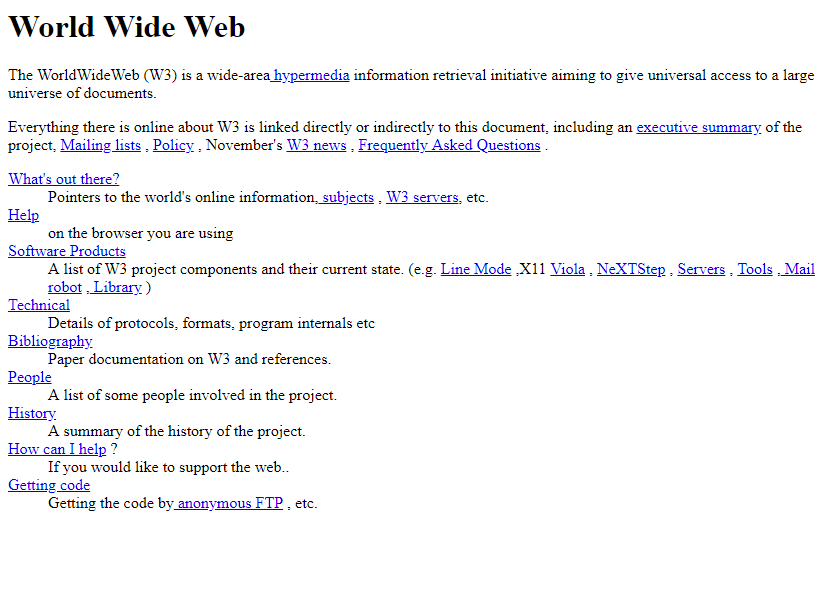
The early web looked pretty boring (see the image below). Just a simple webpage with text. And hypertext (links to other web pages). Maybe one image at the top that would usually display a logo (in case it was run by some organization, which was the case for websites in the early 1990s). No bloat, no flashing ads, no cookie banners, no annoying pop-ups. Just a webpage with short and direct information about what it is and what it offers. Beautiful. But boring.
The Old Web
The web has always encompassed four broad categories of content distribution: commerical, personal, social, and peer-to-peer. And that came with three groups of people: developers, users, producers. The commercial space was filled with corporate websites that advertised their products, the Corporate Space. The personal space was filled with personal blogs and webpages of personal interest, the Indie Space. The social space was filled with message boards where people could discuss certain topics of interest, the Social Space. The peer-to-peer space was filled with producers (the Scene) and consumers (leechers) of various digital media, the Sharing Space.
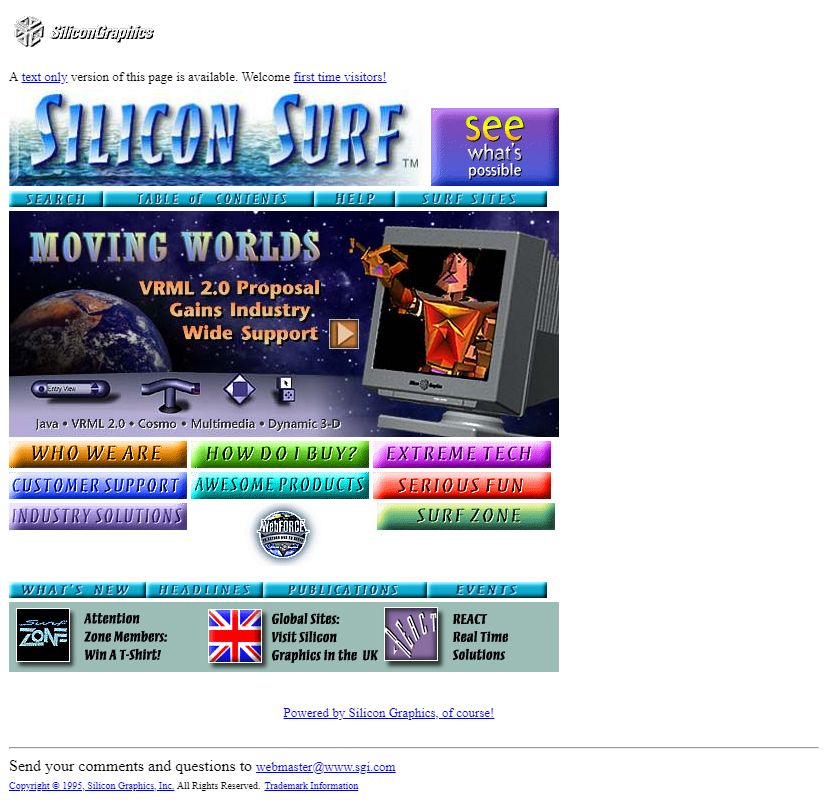
With its growing popularity and wider adoption, new applications called Web Browsers entered the game. In mid 1990s the old web was born. From that period, developers became more creative and would design less boring web pages (see the image below). The HTML table element was heavily used to position elements before CSS was introduced in 1996. There were hundreds of websites by 1994, and the number was rapidly growing, so something called a web directory needed to happen. The most popular web directory was from Yahoo! which launched in 1994, but there were some other before that, like W3Catalog.
You can see how things were growing naturally: when there were thousands of websites, having web directories was not efficient anymore, so there needed to be a search engine that could crawl web pages automatically. So many search engines entered the web and crawled hundreds of thousands of web pages. We already know that the winner in that game was Google, only because they decided to introduce a better searching experience through the implementation of the PageRank ranking algorithm.
The Rising Web
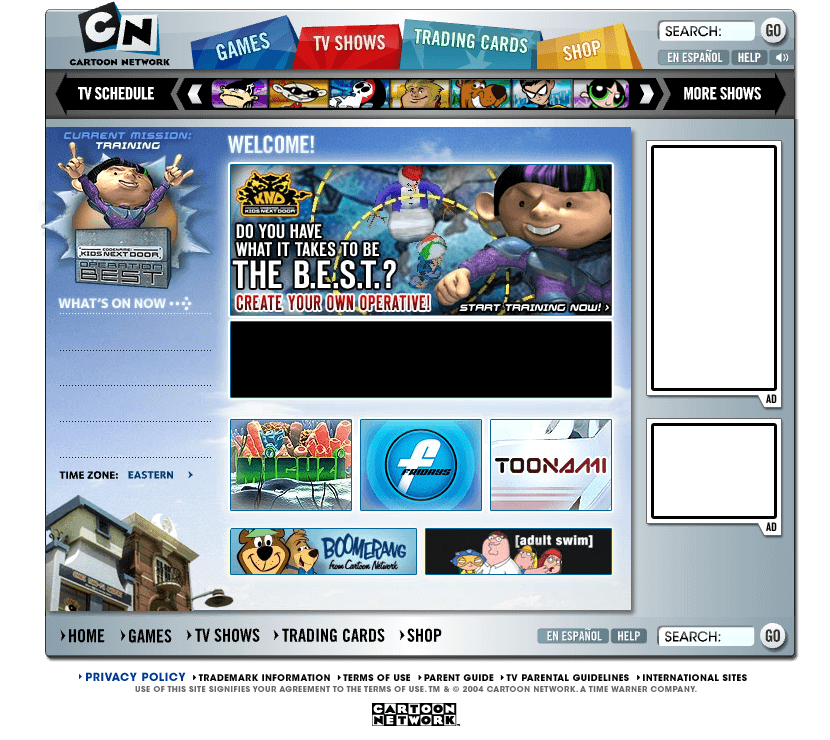
I don't want to coin new terms here, and I am saying this because people call the "old web" anything that is now considered old. Could be from around 1995 to 2010. Or maybe 2015. I don't know. I don't think anyone knows. But it becomes more clear once you see how websites changed over time. For example, the rising web can still be considered the old web, but I want to have the distinction between the old web and the "Old Web", if that makes sense (one is old relative to us, and another is actually old). This one is somewhere around 2001-2010.
Even though websites became slightly prettier, they still looked alike (not all of them). There could be many reasons to that, but the most common ones that make sense: most people aren't that creative; people like to copy what they see makes the most sense to them, design-wise. This is still true, not just when it comes to website design (e.g., industrial design, fashion design, architecture). "If this major tech company uses flat design, then we should, too!". Also, people experiment with possibilities that the technology gives them; so in case the possibilities are small and limited, most things will share the same aesthetic (just like with all NES games being limited to a certain color palette).
There's even more information. It's overwhelmed with information. Especially with the birth of Wikipedia (the free encyclopedia!). It's an information portal, you could say just like websites from the early web. The Social Space and the Indie Space merged into Socialindie Space. OK, that sounds ridiculous, but the point is--there's this, sort of, hybrid space that emerged as something that serves people without turning them into a product (like modern social media platforms do). It's a collaborative place where people contribute information for everyone, as a free source of knowledge.
But with the rising web also comes a rising incentive for corporations to make money. Through advertisement. With more people, there are more different incentives and means to achieve their goal. That includes scamming people, false advertisement, phishing, viruses, and pop-ups. The web becomes a dangerous place for a person who is not aware of its dark side, i.e. an average person who is not tech savvy. This was also the age of forums, image boards, gaming portals (GameSpy), instant messengers (AIM, MSN, ICQ). It was dangerous, but beautiful. But the web rises, so some things will inevitably change; by the mid 2000s, there are now hundreds of millions of people (or, perhaps, almost one billion people) on the web, social media platforms start emerging, attempting to conquer the Social Space. Blogging platforms attempt to conquer the Indie Space. File hosting providers attempt to conquer the Sharing Space, thus having the Corporate Space become the Stalkerspace Mafiaspace black hole of the web, sucking all beauty and joy of interacting, owning, and sharing. *Face with a tear*. Anyways.
The Popular Web
Heavily used by Apple, skeuomorphic design was becoming more and more popular, so by the end of 2000s there have been many websites and applications that used it for icons and even for the interface. From late '90s to late 2000s, technologies such as JavaScript, PHP, Perl, and Flash were popular for web development. Flash was in particular a rapidly growing technology, because it was used for creating interactive experiences, which also allowed to create games that could be played inside of the web browser. I can't go on without mentioning Flashpoint Archive if you're nostalgic about those Flash games.
In early 2010s the social media platforms boomed like never before: places like Twitter, that was quite obscure (people didn't know what to use it for, even Twitter was struggling to justify its purpose with frequent front page redesign attempts); among others were Tumblr, Reddit, YouTube, Instagram, Foursquare, Plurk, Yelp, Formspring, LiveJournal, Flickr, etc. While forums were popular during the rising web, during the popular web the social networking platforms quickly conquered the majority of the web audience. Don't get me wrong, forums still exist and are doing pretty well. They are just not in the mainstream's attention.
Take a moment to think about it: most of those platforms existed during the rising web, and they did have a huge userbase, but not as huge; what changed is that more people who got access to the internet (and thus the web) got to see the web as what it is at that particular timeline, so they might think that the web is when you join these social media platforms and "become part of the discussion". Your mom, your dad, your non tech savvy siblings, relatives that live in the middle of nowhere, your librarian that types in the search bar "please find...". This is the age of mainstream. You're supposed to join that Facebook group, you're expected to have a LinkedIn profile, you need an email address to log into your bank app.
The Modern Web
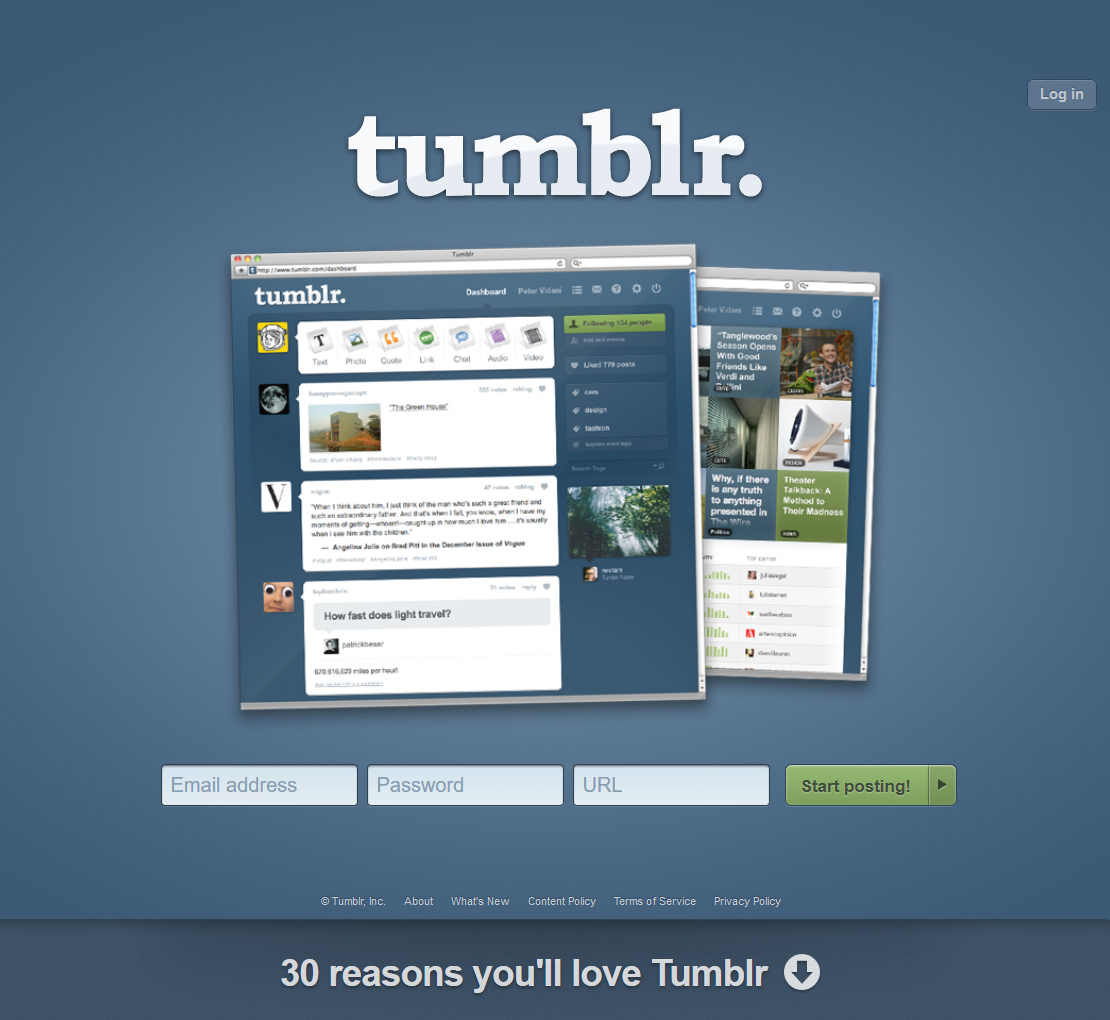
Many design trends have emerged and died quickly during 2010s. That's thanks to major players in tech like Apple (skeuomorphic and flat design), platforms such as Dribbble (long shadows on icons) and Behance (landing pages). The startup culture was exploding and around ~2017-ish most websites started being obsessed with the landing page layout. Flat design, huge title that occupies the entire front page and forces you to scroll down to learn more, walls of text, filler illustrations. Basically, a nothingburger.
Blogger was replaced with WordPress, the vast majority of websites look the same. All news websites look the same--image, title, description. Everything is in a card format. Rounded cards, square cards, three cards occupying the entire screen. Too much information. No identity. Everyone is obsessed with crypto and blockchain and falsely claim it's the core of Web 3.0. Cookie banners, trackers, modals (pop-ups!) that beg for subscription or offer a discount, even more ads, ad pop-ups, unskippable ads in videos, pay premium for no ads (but there are still ads), monopolies, gatekeeping, cryptopsychosis. The Corporate Space is going wild.
Quite a shitshow. Oh, forgot about doomscrolling, doomswiping, brainrot, influencers, looksmaxxing, stalkers, cancel culture, rise of far right social media, echo chambers, multiple attempts to censor and age-restrict the web, and successfully dodged anti-trusts. Those things became more prevalent. TikTok replaced Twitter's Vine, which led us to the age of brainrot. We are now witnessing kids growing up watching cocomelon instead of the quality animated films of the '90s. Everyone needs to hit that like button and subscribe and leave a comment below. The numbers should go up, and everyone has that opportunity, everyone can one day become a celebrity and get the attention that they deserve.
Monetize your looks, monetize your thoughts.

The Next Web
We are now entering the next web. Most websites will be AI-generated. The same landing pages will persist. The websites will share the same artificial aesthetic. The websites have no soul anymore. The products that are being made went from being native applications to web apps to useless subscription-based web services. People dreamed of building something but couldn't. The natural selection was temporarily postponed with the rise of LLM tools that allowed those who hacked their way into becoming a developer to ship a slop that allegedly solves some problem.
Excitement, confusion, fascination, psychosis, anger, uncertainty, depression. A total rollercoaster. People don't know how to feel about this. Everything is infested with AI: ads, videos, illustrations, writings. They shove it down your throat with the premise it improves your productivity. Some absolutely hate AI, some are fully devoted to it, some are maintaining a balance, and some are not yet in the loop. Notice how things have deteriorated because of the wider adoption of the technology, because highly skilled developers were replaced by salesmen and product managers, because everything is driven by the hunger for more profit and more valuable stock. Companies across the industries spent the last decade optimizing for profit. With AI, they optimized away the jobs.
Everyone is online. Incentives have shifted towards establishing your online presence and maintaining relationships through online means. Life maintains the balance, so with every positive (e.g., technology becoming more accessible) comes a negative (e.g., degradation in quality and loss of jobs). It's easy to look back in time and see how things emerged in a sensible way: directories, search engines, platforms. But it's not as easy to see the future, what awaits us with the technology we have now. The world did not see LLMs coming. We were not ready for it. And now that we have it, we have no other choice than to accept it.
I am not going to include a screenshot of an AI generated website. I can't decide which one, because I ignore them.
* * *
This sounds like we are doomed. But. Let's live up to the title of this writing. Remember what I said about "what changed is that more people who got access..." and "...forums still exist...". This is to say, we still have the web. We can build websites. We can build communities. And there is this growing commitment by the members of the indie space to create new directories for personal blogs. There's been a slow rise of decentralized networks, the fediverse. There's been a pushback against corporate shenanigans. There are many who abandoned their personal websites in favor of corporate platforms (e.g., Substack), but there are also many who decide to create a personal website for the first time. We need to encourage more people to do this. Not to be part of some cool blogging service, even if it's "for the indies", but to build your own space.
Buttons of the old web are the symbol of remembering the good ol' times, when things were much simpler. Before influencers, before the brainrot, before corporations took all the traffic from the indie space. Those buttons were popular during the Old Web, they were fancier links to some downloadable content (e.g., web browsers or Flash Player) or technologies ("built with...", "powered by..."). They were usually 88x31 pixels in size; static or animated. Some were almost the same size but slightly bigger and those were called badges. They could feature friend blogs or mocking technologies. You'd think it's such a small thing from the past, why would anyone bother to preserve something like that among other things. That's because they were pretty, simple, and were an image file you could easily save. Take a look at the Microsoft's website from 1996:
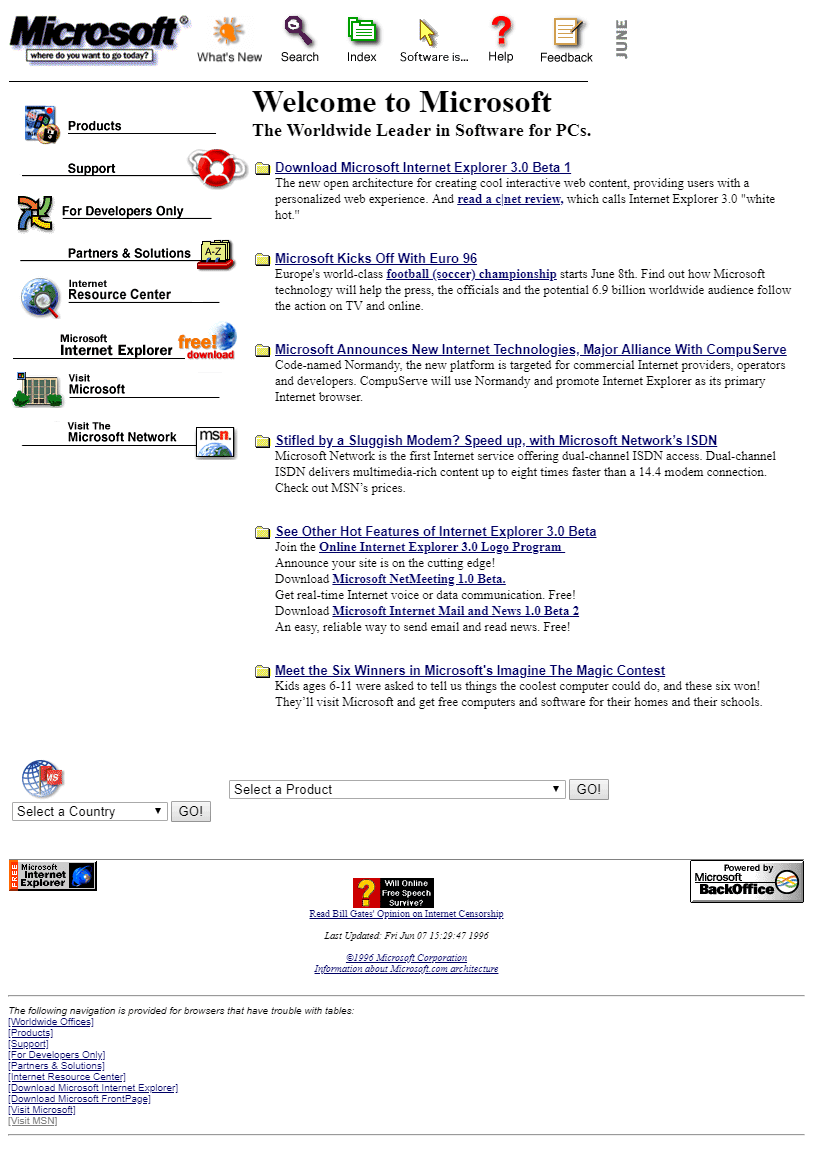
At the bottom of the page you can see three small rectangular images: on the left is the 88x31 button (animated GIF), on the center is a button-sized banner, and on the right is a badge. If you've visited the About page of my blog (this website), you could see at the bottom a button that says "VALID RSS". Back in a day it could've looked annoying to me. But, these days I feel nostalgic and it makes me feel better about my blog. Especially, since I never had a blog or an RSS feed, so starting one and implementing the feed was quite an achievement, and (don't want to pat my own back) I did it in a really good way (if you open it, it renders as a web page and not a raw XML file), which is something I've never seen anyone else do.
I like the indie web, I like that there are people who feel the need to push back and not let the corporate space to indulge them to become their product. The last week I've spent some of my free time designing my own buttons, and make them look modern. I thought to myself "if they were popular again, how would they look like today? What technologies would they advertise?". Of course, by popular I don't mean mainstream. Ignore the mainstream. I mean those who find this stuff interesting. And this is what we should focus on. We should focus on what we find valuable, and it's OK if we are not earning money doing that stuff, if we don't become famous or get featured on a corporate platform.


And some that do not feature any technology:


Buttons of the indie web are the hope for me that the beauty of the web is not gone. That it's in discovery. That the indie space is still alive. We can find sites that are beautiful, interesting, meaningful, entertaining, educational. It's hard to find those, because they are a needle in a haystack. That's why some personal websites--just like at the times of the old web--are featuring the Links section where they share links to other personal websites so it's easier to discover them. I decided to make one, too. There are several places where you can find old buttons: one, two, three, four, five, six, seven.
If you made it to the end, I am glad you stopped by to read this. Maybe you should make a website, just for the sake of it. And make your own button.
